Debt Snowball vs Debt Avalanche: Which Pays Off Debt Faster in 2026?
Debt avalanche saves more in interest — but debt snowball has a higher completion rate. See both methods modeled on real scenarios, then calculate yours.

Yulia Lit
Consumer Psychology & Behavioral Economics Researcher
Debt Snowball vs Debt Avalanche: Which Pays Off Debt Faster in 2026?
Americans carry an average of $6,380 in credit card debt as of Q1 2026, with the average credit card interest rate at 21.47% APR — the highest on record, per the Federal Reserve's G.19 Consumer Credit report. For a household carrying four debts across credit cards, a car loan, and student loans, the question of which debt to pay first is not a minor optimization — it is the difference between a 4-year payoff and a 9-year one, and potentially $12,000–$18,000 in total interest paid.
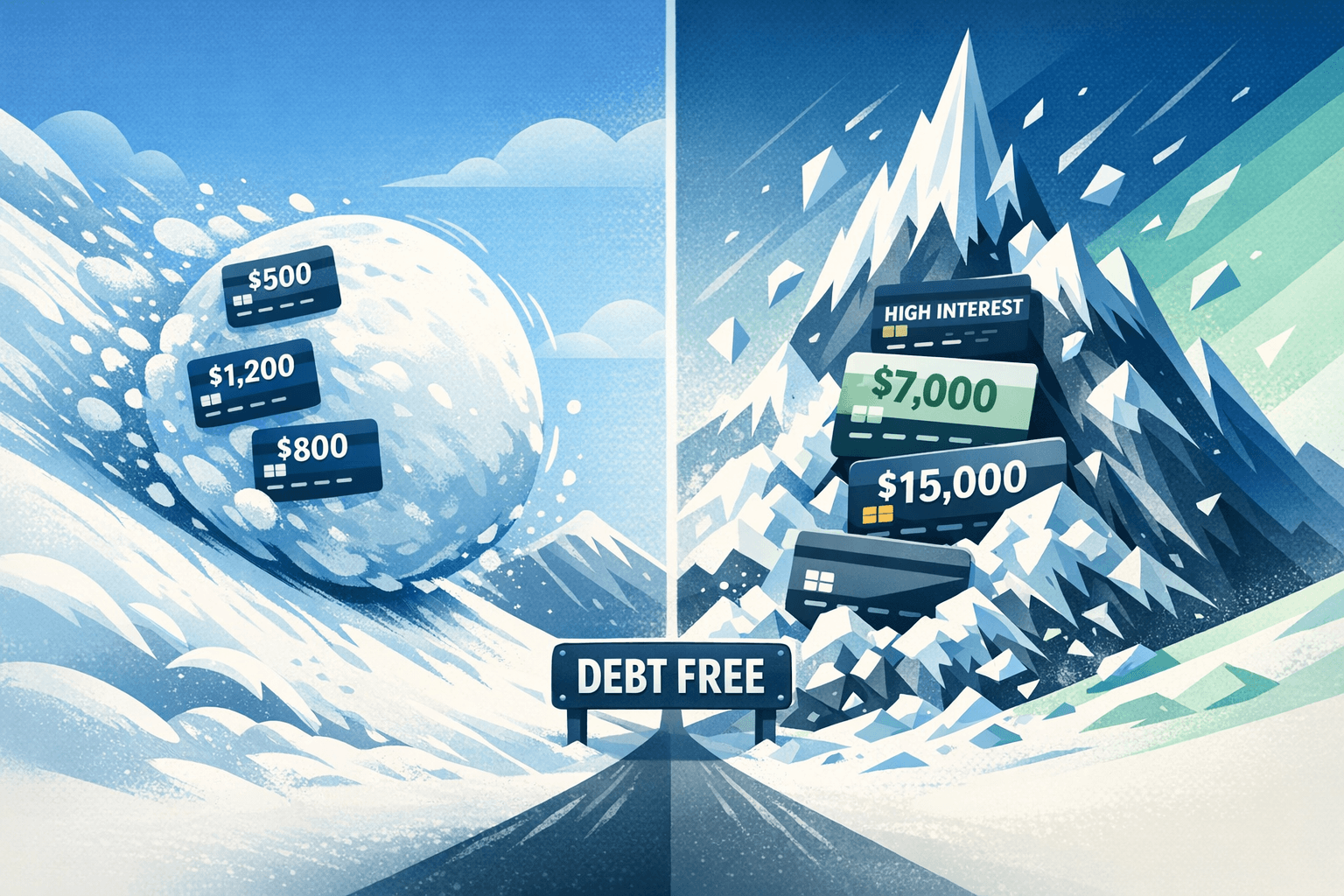
Two methods dominate the personal finance debate: the debt snowball, which pays the smallest balance first regardless of interest rate, and the debt avalanche, which targets the highest-interest debt first regardless of balance size. The mathematically correct answer is the avalanche. The behaviorally correct answer is more complicated.
Key Takeaways
- Debt avalanche eliminates the highest-APR debt first — it minimizes total interest paid and is mathematically optimal
- Debt snowball eliminates the smallest balance first — it produces faster early wins and has documented higher completion rates
- The interest savings difference between the two methods depends on your specific debts — for some debt profiles it is negligible; for others it is thousands of dollars
- Behavioral research supports the snowball method for people who have previously abandoned debt repayment plans — the psychology of early wins is real and measurable
- The best method is the one you will maintain for 3–5 years; quitting the avalanche in Month 6 costs far more than the snowball would have
- A hybrid approach (one snowball quick win, then avalanche for the rest) captures both benefits in most debt portfolios
What Is the Debt Snowball Method?
The debt snowball method, popularized by Dave Ramsey, works as follows:
- List all debts from smallest balance to largest balance (ignore interest rates completely)
- Pay the minimum payment on every debt
- Direct every extra dollar of payment toward the debt with the smallest balance
- When the smallest balance is paid off, roll its full payment (minimum + extra) onto the next smallest
- Repeat until all debts are paid
The name comes from the growing momentum: each paid-off debt releases a payment amount that gets added to the next target, creating an accelerating "snowball" of payment power aimed at each successive debt.
Example (Snowball order):
| Debt | Balance | APR | Min. Payment |
|---|---|---|---|
| Store credit card | $480 | 28% | $15 |
| Medical bill | $1,200 | 0% | $50 |
| Car loan | $8,500 | 7.9% | $240 |
| Student loan | $22,000 | 5.5% | $230 |
Snowball attacks the store credit card first ($480), regardless of the 28% interest rate. Once paid off, the freed $15 is added to the next target.
Tip
Research by Moty Amar, Dan Ariely, and colleagues published in the Journal of Marketing Research found that people who paid off one small debt early reported significantly higher confidence in their ability to become debt-free than those who hadn't yet eliminated any single debt — even when their total remaining debt was larger. A single "paid off" account is psychologically disproportionately motivating.
What Is the Debt Avalanche Method?
The debt avalanche method targets interest cost rather than balance size:
- List all debts from highest APR to lowest APR (ignore balances)
- Pay the minimum payment on every debt
- Direct every extra dollar toward the debt with the highest interest rate
- When the highest-rate debt is paid off, roll its full payment onto the next highest rate
- Repeat until all debts are paid
Using the same example as above, the avalanche attacks the store credit card first also — because 28% APR is the highest. But if the medical bill were a 0% balance transfer and the store card were only 12%, the avalanche and snowball would diverge: avalanche would target the 12% store card while snowball would still target the $480 balance first.
The avalanche saves more money in total interest paid because it eliminates the most expensive debt fastest, preventing high-interest charges from accumulating on large balances.
Side-by-Side Comparison
| Factor | Debt Snowball | Debt Avalanche |
|---|---|---|
| Payoff order | Smallest balance first | Highest APR first |
| Total interest paid | Higher (sometimes significantly) | Lower (sometimes significantly) |
| Time to first debt eliminated | Faster (if smallest balance differs from highest rate) | Same or slower |
| Psychological momentum | Strong — quick early wins | Depends on debt profile |
| Completion rate | Higher among people with prior failed attempts | Lower if high-APR first debt has a large balance |
| Best for | People motivated by milestone progress | People motivated by minimizing cost |
| Complexity | Simple | Simple |
Which Method Saves More Money? A Real Example
Debt profile:
- Credit card A: $2,200 balance, 24% APR, $44 minimum
- Credit card B: $4,800 balance, 19% APR, $96 minimum
- Car loan: $11,000 balance, 7.5% APR, $220 minimum
- Personal loan: $6,500 balance, 14% APR, $130 minimum
Extra monthly payment available: $300 Total extra beyond minimums: $300/month
| Debt Snowball | Debt Avalanche | |
|---|---|---|
| Months to debt-free | 43 months | 41 months |
| Total interest paid | $7,840 | $6,910 |
| Interest savings | — | $930 |
In this example, the avalanche saves $930 in interest and pays off the debt 2 months faster. The difference is real but not catastrophic — which is why the behavioral argument for the snowball deserves serious weight for people who have history of abandoning repayment plans.
For debt portfolios where the highest-rate debt is also the largest balance (common with student loans at 6–7% vs. a $500 medical bill at 0%), the snowball and avalanche produce nearly identical outcomes — making the behavioral advantage of the snowball a clear tiebreaker.
Calculator
Debt Snowball vs Avalanche — Your Numbers
Add your debts below to see exactly how each method performs with your specific balances and interest rates.
The Behavioral Economics Case for the Snowball
The intuition that "just do the avalanche, it's objectively better" ignores a substantial body of behavioral research on goal completion and financial motivation.
Amar, Ariely, Ayal, Cryder, and Rick (2011) in the Journal of Marketing Research run a series of experiments on debt repayment behavior. Their finding: people who paid off an entire debt account — even a small one — were significantly more likely to maintain their repayment plan through all subsequent debts than people who had reduced multiple debts proportionally by the same amount. The completion of a discrete goal (eliminate this specific account) triggers a different psychological state than progress toward a distant goal (reduce total debt from $30,000 to $29,200).
This maps to the "goal gradient effect" identified by Columbia Business School researcher Ran Kivetz: people accelerate their effort as they approach a visible finish line. The snowball creates multiple visible finish lines. The avalanche creates one distant one.
For people who have failed to sustain debt repayment before — which describes the majority of people with credit card debt, given US revolving debt statistics — the probability of completing the debt payoff journey matters as much as the mathematical optimum at the end. A completed snowball beats an abandoned avalanche by tens of thousands of dollars.
Warning
Switching methods midway is more expensive than either method applied consistently. If you start with the avalanche, attack a $4,800 high-rate balance for 8 months, then abandon due to motivational fatigue, your $4,800 is now $4,200 and you have paid $400 in interest without eliminating any single debt. The psychological deflation of paying down (but not paying off) a debt is well-documented. Whichever method you choose, choose it based on your honest self-assessment of sustainability, not theoretical optimality.
The Hybrid Approach: One Snowball Win, Then Avalanche
For most debt portfolios, an effective middle path exists:
- Identify your smallest balance that can be paid off in 1–2 months. Pay it off first using aggressive extra payments. This delivers the early completion milestone immediately.
- Switch to avalanche ordering for all remaining debts. With the motivational foundation of one completed account, apply interest-rate ordering for maximum efficiency.
This works best when:
- You have one small balance (under $500–800) that can be eliminated within 60 days
- Your remaining debts are large enough that interest rate differences are meaningful
- You have some history of budget or debt plan abandonment and want the early win to anchor commitment
The mathematical cost of paying one small low-rate debt before switching to avalanche is typically $50–$200 in additional interest — a modest price for a substantially higher completion probability.
Which Should You Choose?
Answer these three questions:
1. Have you previously started and abandoned a debt repayment plan? If yes → snowball. Your history indicates that sustaining motivation through long timelines without visible progress is difficult. The early wins are not a psychological trick — they are the mechanism by which you maintain the plan long enough for it to work.
2. Is your highest-rate debt also your smallest or near-smallest balance? If yes → avalanche and snowball are identical. Apply the avalanche without any cost.
3. Is the total interest difference between the two methods more than $2,000? Use the calculator above to check. If yes and you have never failed to maintain a financial commitment — avalanche. If yes but you have abandoned past plans — still consider snowball or hybrid, because the difference assumes you complete the avalanche, which is not guaranteed.
Information
Debt repayment motivation is significantly higher when payoff progress is visible regularly — not just at month-end. Yomio's debt tracking view shows remaining balances updating as payments clear, with projected payoff timelines that update based on your actual payment history. Seeing the number move each month is functionally equivalent to the snowball's early wins applied to ongoing progress.
See your debt-free date before you start
Yomio models both payoff methods against your real debt balances and shows which path gets you debt-free fastest given your specific numbers.
Calculate my payoff date