50/30/20 Rule: How It Works (And When to Adjust It) in 2026
The 50/30/20 rule is the most popular budget method — but it breaks when rent exceeds 30% of income. Here is how to use it, fix it, and track it automatically.

Yulia Lit
Consumer Psychology & Behavioral Economics Researcher
50/30/20 Rule: How It Works (And When to Adjust It) in 2026
The 50/30/20 rule has become the default budgeting starting point for millions of people — simple enough to understand in five minutes, clear enough to act on immediately. But it was designed in 2005, when the average US household spent roughly 27% of after-tax income on housing. In 2026, that figure has risen to 33% and higher in most metro areas, according to the Harvard Joint Center for Housing Studies 2025 State of the Nation's Housing report.
That single change breaks the model's first and largest category before you get to step two.
This guide explains what the rule actually says, when it works, when it needs modification, and how to adapt it to your real income and cost structure — including a calculator that builds your personalized version.
Key Takeaways
- The 50/30/20 rule allocates 50% to needs, 30% to wants, and 20% to savings and debt repayment — all calculated from after-tax income, not gross salary
- The rule was created by Senator Elizabeth Warren and her daughter Amelia Warren Tyagi in their 2005 book All Your Worth as a framework for financial stability, not a rigid prescription
- The biggest failure mode is miscategorizing wants as needs — the rule only works if you are honest about which category each expense belongs to
- High-cost cities (New York, San Francisco, Boston, Seattle) routinely push housing alone past 35–40% of after-tax income — a straightforward modification exists for this
- The rule is most useful as a diagnostic tool, not a straitjacket: see your current split, then decide what to adjust
What Is the 50/30/20 Rule?
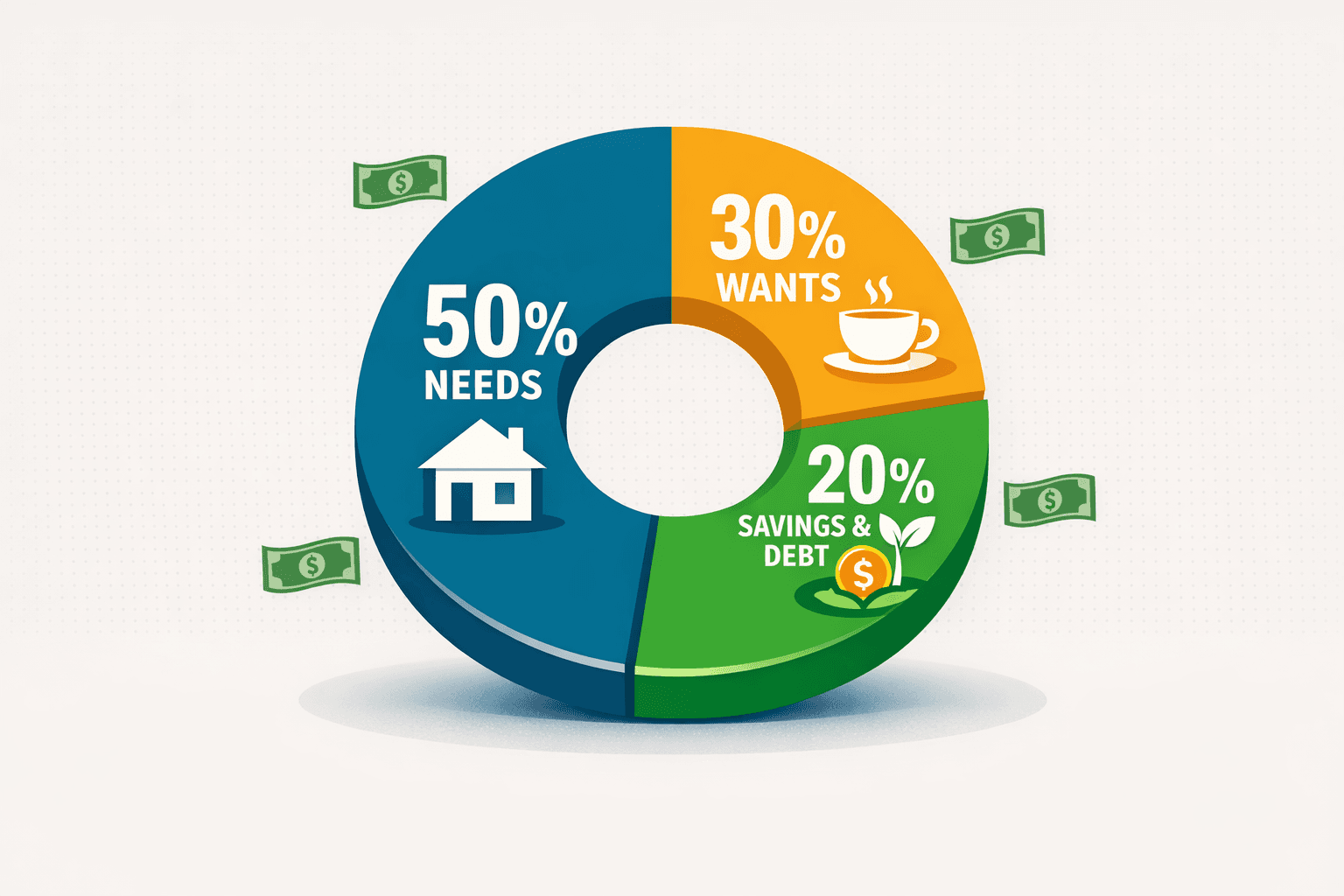
The 50/30/20 rule divides your after-tax monthly income into three categories:
- 50% Needs — expenses that are non-negotiable: rent or mortgage, utilities, groceries, minimum debt payments, insurance, transportation to work
- 30% Wants — discretionary spending that improves quality of life but is not essential: dining out, streaming services, gym memberships, travel, entertainment, clothing beyond basics
- 20% Savings and debt repayment — emergency fund contributions, retirement accounts (401k, IRA), extra debt payments above minimums, other savings goals
The logic is straightforward: if needs consume no more than half your income, you have enough room for both enjoying life and building financial security simultaneously. The method was designed to prevent the most common budgeting failure mode — people who either deprive themselves until they break, or spend freely until they have no savings, with nothing sustainable in between.
Information
The 50/30/20 rule uses your take-home pay — what actually hits your bank account after federal and state taxes, Social Security, and Medicare. If your gross salary is $70,000 but your take-home is $52,000, you are budgeting on $52,000. Many people miscalculate this by using their pre-tax salary and then wonder why their numbers do not add up.
Step 1: Calculate Your Real After-Tax Monthly Income
For salaried employees, this is your net pay — visible on any pay stub.
For people with variable or multiple income streams (freelancers, contractors, part-time employees, people with side income), use a 3-month average of actual deposits. The IRS provides guidance on calculating variable income for self-employed individuals, including how to account for self-employment tax in your take-home calculation.
Formula:
- Annual gross salary ÷ 12 = monthly gross
- Monthly gross × your effective tax rate = taxes
- Monthly gross − taxes − pre-tax deductions (health insurance, 401k contribution) = your working number
Example: $65,000 gross salary → approximately $4,417/month after federal income tax at 22% bracket, state tax, and Social Security/Medicare. Add back any pre-tax 401k contributions you make (they already count toward your 20% saving allocation).
Step 2: Define Your Needs Honestly
This step is where the rule most commonly breaks. People systematically over-count their needs.
Definitional test: A need is an expense you would pay before anything else because failing to pay it creates a genuine consequence — eviction, inability to get to work, loss of health coverage, defaulting on debt.
Genuine needs (50% category):
- Rent or mortgage (including renter's/homeowner's insurance)
- Utilities: electricity, water, gas, heat
- Groceries (basic nutrition — not prepared meals or restaurant delivery)
- Minimum payments on all debt (credit cards, student loans, car loan)
- Health insurance premium
- Transportation to work: public transit cost, or car payment + gas + insurance if driving is required for your job
- Childcare costs that enable you to work
Common misclassifications into "needs":
- Gym membership (a want — there are free alternatives)
- Streaming services (a want — entertainment is discretionary)
- Phone plan above basic (the phone itself is a need if required for work; the premium plan is a want)
- Dining out "because I don't have time to cook" (a want with a productivity justification)
- Brand grocery items vs. equivalent store brands (the brand premium is a want)
- Any subscription that provides convenience rather than essential function
Warning
The longer you have maintained a spending habit, the more it feels like a need. A $60/month wine or coffee subscription does not become a need because you have paid it for three years. Run each recurring charge through the definitional test: what specific consequence follows if you cancel it? If the answer is "inconvenience" or "I would miss it" — that is a want.
Step 3: Set the 30% Wants Limit
Once your needs are correctly identified, the 30% wants category covers everything else that makes life enjoyable — intentional spending that aligns with what you value.
This category is not the enemy of financial health. Sustainable budgeting methods that acknowledge human desire for enjoyment have dramatically higher long-term adherence rates than restrictive approaches. The 30% allocation is the method's built-in acknowledgment that deprivation-based budgets collapse.
Practical application of the wants 30%:
- Dining out and restaurant delivery
- Bars and entertainment
- Streaming, music, and gaming subscriptions
- Gym, hobbies, and sports
- Travel and vacations
- Clothing beyond functional necessity
- Gifts
- Non-essential home goods, décor, gadgets
If your wants regularly exceed 30%, the fix is not to eliminate enjoyment — it is to identify which categories deliver the most satisfaction per dollar and redirect spending there. Research by Dunn, Gilbert, and Wilson on money and happiness consistently shows that experiences produce more lasting satisfaction than possessions, and social spending produces more satisfaction than solitary consumption.
Step 4: Assign the 20% to Savings and Debt
The 20% category covers both wealth-building and debt elimination. The split between them depends on your current situation:
If you have high-interest debt (above 7% APR): Direct the majority of the 20% to debt repayment above minimums. The guaranteed return of eliminating 20% APR debt exceeds virtually any investment return available.
If you have no high-interest debt: Direct the full 20% to savings in this order: employer 401k match first (free money with 100% return), then emergency fund to full target, then IRA (Roth or traditional), then taxable investment account.
Minimum debt payments are already in the 50% needs category — the 20% allocation covers additional debt payments beyond minimums, which accelerates payoff. Paying only minimums on credit card debt while not allocating extra to it means the debt will survive years or decades due to compound interest. The CFPB's debt repayment resource explains minimum payment implications clearly.
Calculator
Your Personalized 50/30/20 Budget
Enter your take-home income and rent to get a split adjusted for your actual cost of housing.
Leave blank if you want the standard 50/30/20 split.
When the 50/30/20 Rule Breaks (And What To Do)
Problem 1: Housing Costs Above 30% of Income
This is the most common structural failure in 2026. In cities like New York, San Francisco, Boston, Seattle, Miami, and Denver, median rent for a one-bedroom apartment exceeds 35–45% of median after-tax income for a single earner. The 50/30/20 rule cannot be applied without modification in these markets.
The fix — modified allocation for high-cost cities:
| Housing as % of Income | Suggested Modified Split |
|---|---|
| 30–34% | 52/28/20 — minor adjustment, hold the 20% |
| 35–39% | 55/25/20 — compress wants, protect savings |
| 40–44% | 60/20/20 — significant compression, minimum wants |
| Above 45% | The math does not work without either increasing income or relocating — no adjustment can fix structural unaffordability |
The 20% savings allocation should be defended aggressively when adjusting for housing — the first instinct is to reduce it, but that compounds the housing cost problem long-term by eliminating the ability to build a down payment or financial resilience.
Problem 2: Variable or Irregular Income
Freelancers, contractors, and gig workers cannot apply the rule to a fixed monthly income because the monthly income is not fixed. The correct adaptation:
Use your minimum income month as the base. Calculate your lowest-income month from the past 12 months. Apply the 50/30/20 percentages to that floor. In higher-income months, direct the surplus to savings (building toward your emergency fund target of 9–12 months, appropriate for variable income) before increasing discretionary spending.
For more detail on budgeting with variable income, see our guide to paycheck-to-paycheck budgeting.
Problem 3: Carrying High-Interest Debt
The standard 20% savings allocation does not account for debt that is actively compounding against you. If you have credit card debt above 15% APR:
Temporary modification: Allocate 10% to essential savings (emergency fund minimum) and redirect the other 10% to high-interest debt repayment, stacking it with the minimums already in your 50% needs column. Once the high-interest debt is eliminated, shift the full 20% back to building out the emergency fund and then investing.
Tip
Before enforcing the rule as a budget, run your last 3 months of actual spending through it. Look at what percentage you are actually spending on needs, wants, and savings/debt. Most people discover they are already allocating 60–65% to needs, 30–35% to wants, and 5–10% (or zero) to savings. The gap between actual and target is the information you need — the rule tells you what to adjust and by how much.
How to Track Your 50/30/20 Split Automatically
The rule is simple in theory and friction-heavy in practice when tracking manually. Manually categorizing transactions month after month is the primary reason people abandon budgeting systems they set up correctly.
Yomio automatically categorizes every transaction and assigns it to a budget category as it comes in — without requiring you to copy transactions into a spreadsheet. Its dashboard shows your current needs/wants/savings split in real time, including alerts when a category approaches its limit before the month ends. You see the split without calculating it.
For a full comparison of budgeting apps and how they handle category tracking, see YNAB alternatives: which budget app actually works.
Track your 50/30/20 split automatically
Yomio categorizes every transaction and shows your real needs/wants/savings split in real time — no spreadsheets.
Try Yomio free