The 50/30/20 Budget Rule: How It Works and When to Adjust It
The 50/30/20 rule is a budgeting starting point: plan take-home income across needs, wants, and savings or debt. Learn how to adapt it to your actual costs.

Yulia Lit
Consumer Psychology & Behavioral Economics Researcher
50/30/20 Rule: How It Works (And When to Adjust It) in 2026
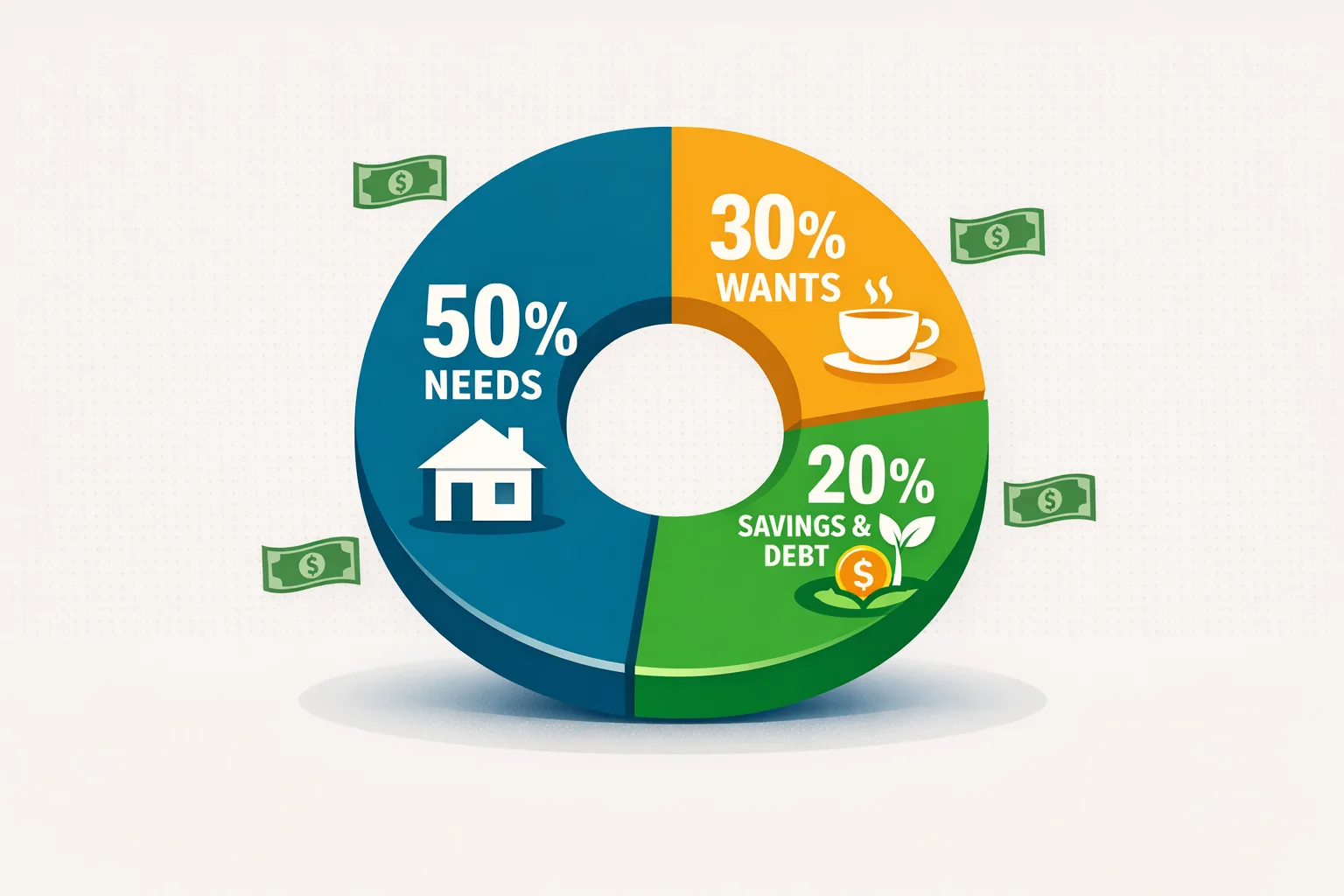
The 50/30/20 rule is a starting framework: plan about 50% of take-home income for needs, 30% for wants, and 20% for savings and debt repayment. Use the percentages to review your spending, then adjust them when your essential costs or priorities do not fit the template. The CFPB describes the rule as one budgeting rule of thumb, not a requirement.
Key Takeaways
- Start with take-home income and sort spending into needs, wants, and savings or debt repayment.
- Treat the percentages as a flexible prompt for review, not a target every household can meet.
- If essential costs exceed half of take-home pay, use your actual costs to plan rather than labeling necessary spending a failure.
What Is the 50/30/20 Rule?
The 50/30/20 rule divides take-home income into three broad groups:
- 50% Needs — expenses that are non-negotiable: rent or mortgage, utilities, groceries, minimum debt payments, insurance, transportation to work
- 30% Wants — discretionary spending that improves quality of life but is not essential: dining out, streaming services, gym memberships, travel, entertainment, clothing beyond basics
- 20% Savings and debt repayment — emergency fund contributions, retirement accounts (401k, IRA), extra debt payments above minimums, other savings goals
The percentages are a simple way to compare a spending plan with a common template. They do not show whether an expense is necessary for your household, or whether a particular savings rate is suitable for your goals.
Information
The 50/30/20 rule uses your take-home pay — what actually hits your bank account after federal and state taxes, Social Security, and Medicare. If your gross salary is $70,000 but your take-home is $52,000, you are budgeting on $52,000. Many people miscalculate this by using their pre-tax salary and then wonder why their numbers do not add up.
Step 1: Calculate Your Real After-Tax Monthly Income
For salaried employees, this is your net pay — visible on any pay stub.
For variable or multiple income streams, choose a baseline that reflects income you can reasonably plan around. You can compare several months of take-home income and revisit the plan when it changes. Use the net pay you receive for the period you are planning. If payroll deductions or irregular pay make that figure unclear, check your pay statements or use a cash-flow worksheet.
Step 2: Define Your Needs Honestly
This step can involve judgment, because households have different obligations and circumstances.
Definitional test: A need is an expense you would pay before anything else because failing to pay it creates a genuine consequence — eviction, inability to get to work, loss of health coverage, defaulting on debt.
Genuine needs (50% category):
- Rent or mortgage (including renter's/homeowner's insurance)
- Utilities: electricity, water, gas, heat
- Groceries (basic nutrition — not prepared meals or restaurant delivery)
- Minimum payments on all debt (credit cards, student loans, car loan)
- Health insurance premium
- Transportation to work: public transit cost, or car payment + gas + insurance if driving is required for your job
- Childcare costs that enable you to work
Common misclassifications into "needs":
- Gym membership (a want — there are free alternatives)
- Streaming services (a want — entertainment is discretionary)
- Phone plan above basic (the phone itself is a need if required for work; the premium plan is a want)
- Dining out "because I don't have time to cook" (a want with a productivity justification)
- Brand grocery items vs. equivalent store brands (the brand premium is a want)
- Any subscription that provides convenience rather than essential function
Warning
The longer you have maintained a spending habit, the more it feels like a need. A $60/month wine or coffee subscription does not become a need because you have paid it for three years. Run each recurring charge through the definitional test: what specific consequence follows if you cancel it? If the answer is "inconvenience" or "I would miss it" — that is a want.
Step 3: Set the 30% Wants Limit
Once your needs are correctly identified, the 30% wants category covers everything else that makes life enjoyable — intentional spending that aligns with what you value.
The 30% figure is a suggested share in this framework, not a promise that every household can allocate that much to discretionary spending.
Practical application of the wants 30%:
- Dining out and restaurant delivery
- Bars and entertainment
- Streaming, music, and gaming subscriptions
- Gym, hobbies, and sports
- Travel and vacations
- Clothing beyond functional necessity
- Gifts
- Non-essential home goods, décor, gadgets
If wants exceed the guide, review the categories and decide which costs matter most to you. Change the plan based on your priorities and obligations rather than relying on a universal ranking of spending.
Step 4: Assign the 20% to Savings and Debt
The 20% category covers both wealth-building and debt elimination. The split between them depends on your current situation:
Decide how to divide this group based on your debts, savings goals, employer benefits, and other needs. Check account terms and consider qualified financial advice where the decision has tax or investment consequences.
Minimum debt payments are already in the 50% needs category — the 20% allocation covers additional debt payments beyond minimums, which accelerates payoff. Paying only minimums on credit card debt while not allocating extra to it means the debt will survive years or decades due to compound interest. The CFPB's debt repayment resource explains minimum payment implications clearly.
Calculator
Your Personalized 50/30/20 Budget
Enter your take-home income and rent to get a split adjusted for your actual cost of housing.
Leave blank if you want the standard 50/30/20 split.
When the 50/30/20 Rule Breaks (And What To Do)
When essential costs exceed 50%
Housing, childcare, health care, transportation, or debt payments can make the suggested split impractical. List the actual bills first, then decide what can change and what must stay. If there is little or no room for savings, the rule cannot create room by itself; look at the full cash flow and available support options.
Problem 2: Variable or Irregular Income
Freelancers, contractors, and gig workers cannot apply the rule to a fixed monthly income because the monthly income is not fixed. The correct adaptation:
For irregular income, plan around income you expect to receive and review the plan when deposits arrive. Some people use a conservative baseline and assign extra income after it arrives; choose a method that fits your income pattern and obligations.
For more detail on budgeting with variable income, see our guide to paycheck-to-paycheck budgeting.
Problem 3: Carrying High-Interest Debt
The standard 20% savings allocation does not account for debt that is actively compounding against you. If you have credit card debt above 15% APR:
Minimum payments and required bills belong in the current cash-flow plan. For extra debt payments, compare interest rates, fees, and repayment terms before choosing an approach.
Tip
Before changing your budget, compare recent spending with the three groups. The difference between your current split and the template can help you identify questions to discuss, but it does not tell you which trade-offs to make.
How to track your split
Record spending in a spreadsheet, budgeting tool, or other system you can review. Check how transactions are entered and categorized, since tools differ in whether they use bank connections, receipt scans, or manual entry. Yomio is a receipt and expense tracker; it does not connect to bank accounts or automatically categorize imported bank transactions. You can use the calculator below to map take-home income to the three percentages, then compare it with records you have reviewed.
Review spending with a plan that fits your household
Use receipt and expense records to review purchases, then compare your own spending with a flexible budget framework.
Try Yomio freeFrequently Asked Questions
More from Yomio