Side Hustle Expense Tracker: Organize Income, Costs, and Tax Records
Record side-hustle income and expenses, keep receipts with business-purpose notes, and review U.S. federal tax records before filing.

Yulia Lit
Consumer Psychology & Behavioral Economics Researcher
Side Hustle Expense Tracker: Organize Income, Costs, and Tax Records
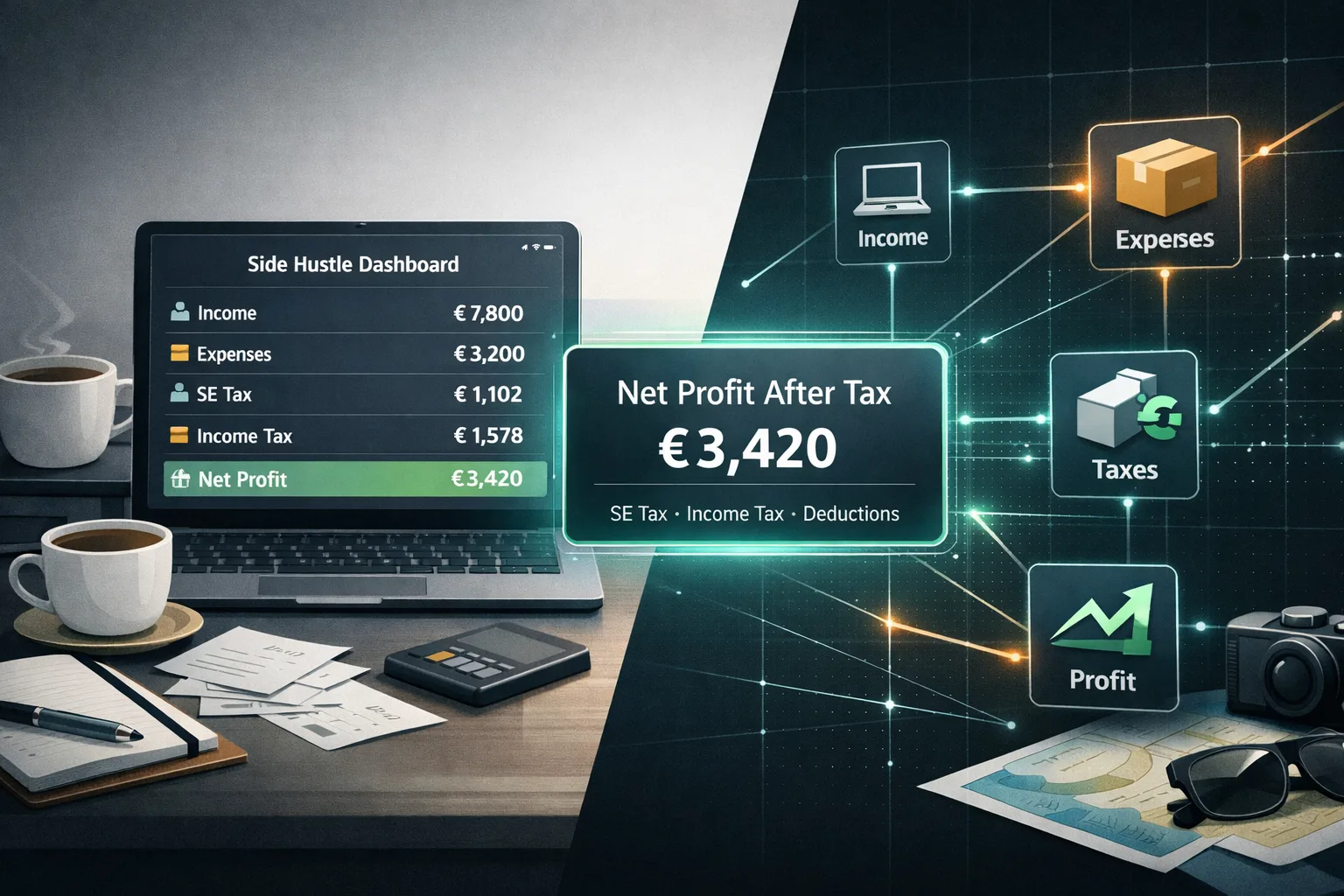
Start with one habit: record each business expense when it happens and keep the receipt with it. This makes it easier to calculate net profit and support deductions you claim at tax time.
Legitimate business expenses can reduce taxable profit, but the tax value of a deduction is not a fixed percentage for every taxpayer. Self-employment tax, income tax, withholding, other income, filing status, and deductions all affect the result. A clear record helps you calculate net profit and support deductions you claim.
This guide shows a recordkeeping workflow and summarizes selected U.S. federal tax rules for 2026. It is general information, not individualized tax advice.
Key Takeaways
- Self-employment tax is generally 15.3% of 92.35% of net earnings; the 2026 Social Security wage base is $184,500 and includes applicable wages from other jobs (IRS Publication 334)
- The $400 net-earnings threshold generally concerns filing Schedule SE and self-employment tax; estimated tax payments use separate tests in IRS Publication 505
- For most 2026 calendar-year filers, estimated-tax due dates are April 15, June 15, September 15, 2026, and January 15, 2027; whether you must pay depends on expected tax, withholding, and credits
- Home-office, mileage, software, and other costs may qualify, but eligibility and record requirements depend on the expense and your situation
- A separate account can make it easier to distinguish business transactions; it does not replace receipts, mileage logs, or notes about business purpose
- Reviewing records throughout the year can make it easier to resolve missing details before tax preparation
How Self-Employment Tax Applies to Side Hustle Income
Self-employed people generally pay both the employee and employer portions of Social Security and Medicare tax. The combined 15.3% rate is applied to 92.35% of net self-employment earnings, not to gross receipts; the Social Security portion is also limited by the annual wage base after applicable wages from other jobs are counted.
Gross receipts are not the same as profit or take-home pay. For example, if monthly receipts are $1,500 and documented business costs for the same period are $500, the difference is $1,000 before taxes and other costs. Tax calculations also depend on the full return, including wages, other income, deductions, credits, and the Social Security wage base. Use current IRS worksheets or a qualified tax preparer for an estimate; this example only shows arithmetic.
Warning
Net self-employment earnings of $400 or more generally require filing Schedule SE, subject to IRS rules. That threshold does not by itself mean quarterly estimated payments are required. For 2026, the general estimated-tax test applies if you expect to owe at least $1,000 after withholding and credits and those payments are below the smaller of 90% of your expected 2026 tax or 100% of your 2025 tax (110% for certain higher-income filers). See IRS Publication 505 for the rules and exceptions. The IRS published a 7% individual underpayment interest rate for October through December 2026; rates are set quarterly in the current IRS interest-rate table.
Compare Income and Expenses You Enter
Enter gross income and expenses for one period in the same currency. The result is arithmetic from your entries, not taxable income, deductible expenses, or a tax estimate.
Recordkeeping arithmetic · no tax rules
Summarize amounts you enter
Use the same currency and time period for every amount. The result subtracts entered expenses from entered gross income; it does not convert currencies or calculate tax.
Expenses for the same period
For a U.S. federal tax estimate, use the current IRS forms and worksheets with your full income and wage information. The IRS self-employment tax guidance explains how Schedule SE applies the 92.35% net-earnings factor, the 15.3% combined rate, and the Social Security wage base.
The 6 Side Hustle Expense Categories to Track
1. Software and Tools
Software costs may be deductible when they qualify as ordinary and necessary business expenses. If a tool has both personal and business use, keep a reasonable record of the business portion. Examples include:
- Project management tools (Notion, Asana, Trello)
- Design software (Adobe Creative Cloud, Canva Pro, Figma)
- Communication tools (Slack, Zoom, Loom)
- Invoicing and accounting software (FreshBooks, Wave, QuickBooks)
- Industry-specific tools relevant to your hustle
Documentation required: Monthly or annual subscription receipt from each service.
2. Marketing and Advertising
Advertising and promotion costs may be deductible when they are ordinary and necessary for your business. Keep invoices and records that show the business purpose.
- Facebook/Instagram/Google Ads spend
- LinkedIn Premium if used for business development
- Stock photo subscriptions
- Domain registration and website hosting
- Business cards, flyers, promotional materials
Documentation required: Receipts from each platform or vendor.
3. Home Office
You may qualify to deduct business use of your home if you meet the IRS rules, which generally include regular and exclusive use for business. The simplified and regular methods have different calculations and limits. See how to track expenses for taxes and the IRS home-office guidance.
Tip
The simplified method generally uses $5 per square foot for up to 300 square feet, subject to eligibility and business-income limits. The regular method allocates qualifying actual expenses. Do not treat a room’s share of rent or utilities as deductible unless you qualify and use the correct method.
4. Professional Development
Courses, books, conferences, and certifications may qualify when they maintain or improve skills in your current trade or business and meet the applicable rules.
- Online courses (Coursera, Udemy, MasterClass if work-related)
- Books and professional journals
- Conference registration and travel to work-related events
- Industry association memberships
Key restriction: The education must maintain or improve skills in your current work. Education for entering a new field is not deductible.
5. Equipment and Supplies
Equipment used for your side hustle may qualify for a deduction, but the method depends on the property, business-use percentage, and current limits. Qualified property acquired and placed in service after January 19, 2025, may qualify for 100% additional first-year depreciation under 2026 law; see IRS Topic 704 and get tax advice about eligibility and elections.
- Cameras, microphones, lighting (for content creators)
- Computers, tablets, external monitors (business portion)
- Tools and materials specific to your trade
- Office supplies (printer paper, ink, notebooks)
Documentation required: Receipt showing purchase date and price. Business-use percentage estimate if the equipment has personal use.
6. Professional Services
Fees for professional services may be deductible to the extent they are ordinary and necessary business costs.
- Accountant or tax preparer fees (for the portion related to your business return)
- Legal fees for contracts, business formation, or IP protection
- Virtual assistant costs
- Outsourced work (contractors paid via 1099)
Setting Up a Side Hustle Tracking System in 3 Steps
Step 1: Separate business and personal activity
A separate account can make it easier to identify business deposits and payments. Compare account fees and balance requirements before choosing one. Bank statements are useful supporting records, but they do not always show what you bought or why it was for business, so keep receipts and notes as well.
Step 2: Capture every receipt at time of expense
Use Yomio to capture receipt details or add an expense manually. Keep the receipt with notes about its business purpose and any business-use share. An app cannot determine whether a cost is deductible or guarantee that a claim will be accepted.
For digital expenses, save invoices and payment records with the same period and business-purpose notes.
Step 3: Set a quarterly estimated tax review date
Before an applicable estimated-tax due date:
- Total net profit from the dedicated account (income minus expenses)
- Estimate required withholding and estimated payments with the current IRS worksheets, including your other income and prior-year tax
- Pay through an IRS payment method by the applicable due date
The time required varies with your income and records. Estimated payments do not guarantee that no balance will be due when you file.
The Most Overlooked Side Hustle Deduction: Half of SE Tax
Self-employed workers can generally deduct one-half of their self-employment tax as an adjustment to income when figuring federal income tax. This deduction does not reduce self-employment tax itself; see IRS Publication 334 for the current rules.
For an illustration only, $18,000 of net profit with no wages subject to Social Security tax produces roughly $2,543 of self-employment tax before the deduction for half of that tax ($18,000 × 92.35% × 15.3%). Actual liability can differ because of wages, other income, deductions, credits, and additional taxes.
Keep side-hustle receipts with your records
Yomio can capture receipt details and manual expense entries. Keep income, tax calculations, and any required books in the records system you use for your business.
Explore receipt trackingMore from Yomio
- How to track expenses for taxes — the complete tax expense documentation guide
- Track business expenses as a freelancer — full freelancer setup for clients, contracts, and taxes
- Zero-based budgeting — give every dollar of side income a job before you spend it
- How to build an emergency fund — protect your primary income when side hustle income fluctuates