How to Track Business Expenses as a Freelancer (2026 Guide)
A practical, country-aware system for recording freelance income and expenses, keeping supporting documents, and checking tax rules with official sources.

Yulia Lit
Consumer Psychology & Behavioral Economics Researcher
How to Track Business Expenses as a Freelancer
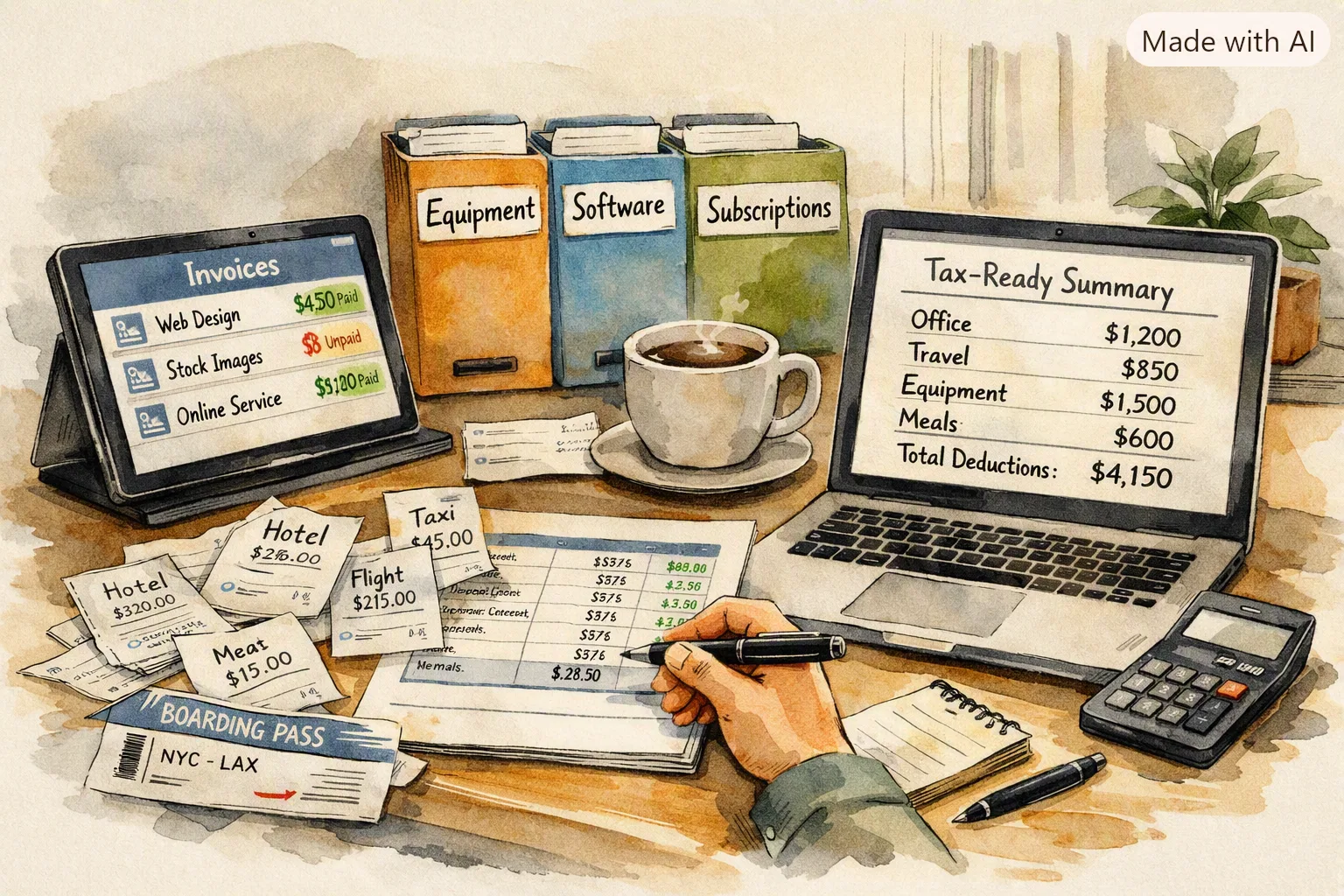
Capture each business expense when it happens, record its purpose, and keep the receipt with the transaction. Review the records regularly and check each deduction and payment deadline with your local tax authority; rules differ by country and business type.
This guide covers a practical recordkeeping workflow and links to official guidance for selected countries. It is general information, not tax or legal advice.
Key Takeaways
- Record the date, amount, supplier, business purpose, and supporting document for each expense.
- Only claim expenses that meet the rules for your country, business structure, and tax year.
- Keep personal and business records distinguishable, even if you cannot use a separate account.
- Record-retention periods and advance-payment rules vary; follow official local guidance.
Warning
Tax treatment, deductible costs, contribution rules, payment schedules, and record-retention periods depend on your country and circumstances. A receipt supports your records, but does not by itself make an expense deductible. Check the official rules or ask a qualified local tax professional.
Why Expense Tracking Is Different for the Self-Employed
Self-employed people often need to keep more detailed income and expense records and may need to make advance payments. The exact duties depend on local rules and business structure.
An expense may reduce taxable business income only when it meets the applicable rules and is properly reported. Good records help you and your adviser determine what can be claimed.
Building records throughout the year can make them easier to review when you prepare a return or meet a filing deadline.
Step 1: Keep Business and Personal Records Distinguishable
If it is available and suitable for your situation, a separate account can make business activity easier to identify.
If you use the same account for personal and business activity, clear notes and supporting documents can help identify the business purpose of each expense.
If a separate account is not practical, keep records that distinguish business and personal transactions.
Tip
Choose an account arrangement that fits your circumstances and account terms. If you keep using one account, record the business purpose and retain supporting documents for each business expense.
Step 2: Organise Common Expense Records
Possible bookkeeping categories include workspace, software, equipment, travel, marketing, and professional services. Use them to organise records; whether an expense is deductible depends on local rules and how it was used.
Home Office
Home-working deductions are jurisdiction-specific. Rules may require a reasonable apportionment of actual costs, a prescribed rate, or a qualifying dedicated workspace. Do not assume a home expense is deductible because you work remotely.
- UK (self-employed): HMRC expenses and simplified expenses and working from home flat rates
- Australia: ATO working-from-home expenses
- Canada (CRA): Business expenses and home-office costs
Professional Software and Subscriptions
Design tools, project management apps, accounting software, cloud storage, website hosting, and domain registration may be business costs when used for the business and allowed under local rules. Keep invoices and record any personal-use share.
Hardware and Equipment
Laptops, monitors, cameras, printers, microphones, and other equipment may be treated differently from day-to-day costs. Check local capital-allowance, depreciation, and expensing rules before classifying a purchase.
Professional Development and Education
Training, books, memberships, and conferences may qualify under local rules if connected to your business. Keep the invoice and a note of the business purpose.
Marketing and Business Development
Website costs, advertising spend, business cards, portfolio platform subscriptions, and similar costs are ordinary business expenses.
Travel and Vehicle Use
Business travel and vehicle costs may be claimable under local rules. Keep a log of dates, destinations, purpose, and distance, and check whether your jurisdiction allows a standard rate or requires actual costs.
Professional Services
Accountant, legal, and professional-service fees may be claimable when connected to the business and permitted by local rules.
Phone and Internet
If a phone or internet service has both personal and business use, keep a reasonable record of the business share and check local rules.
Self-Employed Pension or Retirement Contributions
Pension and retirement contributions have separate rules and limits. Check the relevant plan documents and tax authority guidance for your country before treating a contribution as a business expense or deduction.
Your Deduction Checklist
U.S. federal recordkeeping only
Organize records for review
Choose records you want to gather. This checklist does not decide whether an expense is deductible or reportable.
0 / 6
Step 3: Build a Receipt Capture System That Actually Works
Capture receipts close to the time of purchase so you can connect each document to its amount, date, supplier, and business purpose.
Option A: Receipt App Yomio lets you scan or upload receipts and enter expenses manually. Review the extracted details and keep supporting records; Yomio does not connect to bank accounts or automatically categorize every business expense.
Option B: Email Folder Create a "Business Receipts" folder in your email client and keep digital invoices and receipts with the matching expense records. When you review your books, compare these records with relevant account statements.
Option C: Batch Review If you record expenses in batches, choose a routine that fits your transaction volume and filing obligations. Keep original documents for the period required by the rules that apply to you.
The best system is the one you will actually use. Pick one and commit.
Information
Capture expenses while the details are easy to verify. Reconstructing past records from memory can leave gaps, so use receipts, invoices, statements, and other available records.
Step 4: Organise by Category as You Go
Review records on a schedule that fits your transaction volume. The goal is to find missing receipts, uncategorized items, or expenses that need a business-purpose note before filing.
These categories can help with bookkeeping. Their tax treatment depends on local rules:
| Category | What Belongs Here |
|---|---|
| Professional Services | Accountant, legal, consultants |
| Software & Subscriptions | Tools, SaaS, platforms |
| Equipment & Hardware | Computers, cameras, peripherals |
| Home Office | Rent share, utilities, internet |
| Marketing | Website, ads, design |
| Travel | Transport to client or business events |
| Professional Development | Courses, books, conferences |
| Phone | Business-use portion |
| Insurance | Business and professional liability insurance |
| Pension / Retirement | Self-employed pension contributions |
| Bank & Finance | Business account fees, payment processor fees |
| Other Business Costs | Anything that does not fit above |
Clean categories mean your accountant or tax software pulls exact numbers instead of estimates.
Related: If you're also managing subscriptions as business expenses, our subscription fatigue guide helps you audit what you're actually using.
Step 5: Check Whether Advance Tax Payments Apply
Some tax systems require advance or estimated payments when specified conditions are met. Do not assume that every freelancer owes quarterly payments; check the threshold, calculation method, due dates, and penalties with the relevant tax authority.
How this works in key countries:
| Country | Where to check current rules | Authority |
|---|---|---|
| UK | Payments on account apply only when HMRC's conditions are met; usual due dates are 31 January and 31 July. | HMRC payments on account |
| Australia | Check whether you are enrolled in PAYG instalments and follow the cycle and dates on your notice. | ATO PAYG instalments |
| Canada | Check CRA's instalment conditions and current due dates. | CRA instalment payments |
| US | If you meet the estimated-tax requirements, follow the current Form 1040-ES due dates and payment method. | IRS Form 1040-ES |
Estimate your tax reserve using the rules and rates that apply to your location, income, and business type. If the amount is uncertain, ask a qualified local tax professional; a fixed percentage is not reliable across countries or taxpayers.
Plan Your Recordkeeping Volume
Recordkeeping arithmetic only
Compare entered income and expenses
Enter amounts in the same currency and period. This tool shows totals and their arithmetic difference only. It does not calculate tax or decide what is deductible.
Use the same currency for every amount. This tool does not convert currencies.
Success
Review captured records at a cadence that fits your transaction volume and filing obligations. Look for missing receipts, uncategorized items, or expenses that need a business-purpose note.
Step 6: Keep Records Long Enough
For each expense you intend to deduct, you need to demonstrate:
- Amount — exact value paid
- Date — when the expense occurred
- Vendor — who you paid
- Business purpose — why this was a business expense
- Receipt or invoice — original documentation where available
Keep invoices or other records with the details required by the rules that apply to you. A confirmation email may help, but it may not contain every detail required for your records.
Retention periods differ by jurisdiction, record type, and circumstance. For example, the IRS generally ties U.S. income-tax records to the return's period of limitations, while the CRA generally requires Canadian business records to be kept for at least six years from the end of the relevant tax year. Check current IRS guidance or CRA guidance, and follow the rules that apply where you file.
Warning
A tax authority review is far easier to handle when your documentation is complete. Follow the retention period that applies to each record type and protect stored files from unauthorised access. Keep records longer only when another rule, an active review, or professional advice requires it.
Common Mistakes Freelancers Make
Waiting until a filing deadline to organize records. This can make it harder to match receipts to transactions and verify business purpose.
Relying on unsupported estimates. Keep the transaction details and supporting documents required by the rules that apply to you.
Mixing personal and business activity without clear records. Notes and supporting documents can help distinguish the business purpose of a transaction.
Forgetting annual or irregular expenses. Annual software renewals, professional insurance, and conference fees are easy to forget. A recurring reminder in January to review annual commitments catches these.
Claiming personal expenses as business. Every deduction should have a genuine, demonstrable business purpose. Over-claiming creates risk.
Not keeping transport records. If local rules require details for vehicle or travel costs, record the date, destination, and business purpose.
Tools Worth Exploring
| Tool | Best For | Availability |
|---|---|---|
| Yomio | Receipt scanning, extracted receipt details, and manual expense entry | Global |
| Wave | Free invoicing + accounting | Global (free) |
| FreeAgent | Self-employed bookkeeping, UK tax integration | UK, international |
| Holded | Invoicing, expenses, accounting | Europe-focused |
| Kontist | Freelancer banking + tax estimates | Germany |
| Notion or spreadsheet | Manual category tracker | Global (free) |
Start Now, Thank Yourself Later
The best time to set up your expense tracking system was when you started freelancing. The second best time is today.
Choose a receipt capture method, keep the business purpose with each record, and review it at a cadence that fits your records and deadlines. Use local tax-authority guidance to decide what can be claimed and how long records must be kept.
Keep Receipt Details With Your Expense Records
Scan or upload receipts, review the extracted details, and enter expenses manually when needed. Keep the business purpose and supporting documents together for tax-time review.
Get the AppRelated reading


This article is for informational purposes only and does not constitute tax or legal advice. Tax rules vary significantly between countries and change over time. Consult a qualified local tax professional for advice specific to your situation. For a comparative overview of self-employment taxation across countries, the OECD Taxing Wages report is a useful reference.