Sinking Funds: What They Are, Examples, and How to Set One Up
Learn what a sinking fund means, how it differs from emergency savings, and how to calculate contributions for a known future expense.

Yulia Lit
Consumer Psychology & Behavioral Economics Researcher
Sinking Funds: What They Are, Examples, and How to Set One Up
A sinking fund is money set aside over time for a specific expense you expect to pay later. Estimate the amount you will need, subtract what you have already saved, then divide the remainder by the number of contributions left before the bill is due. For example, if a $900 insurance bill is due in nine months and you have $180 set aside, saving $80 a month would bring the fund to $900 by the due date.
This method can help you plan for annual bills, seasonal costs, and purchases you can schedule. It does not guarantee that every expense will fit your budget, and an estimate may need to change if the cost or due date changes.
What does “sinking fund” mean?
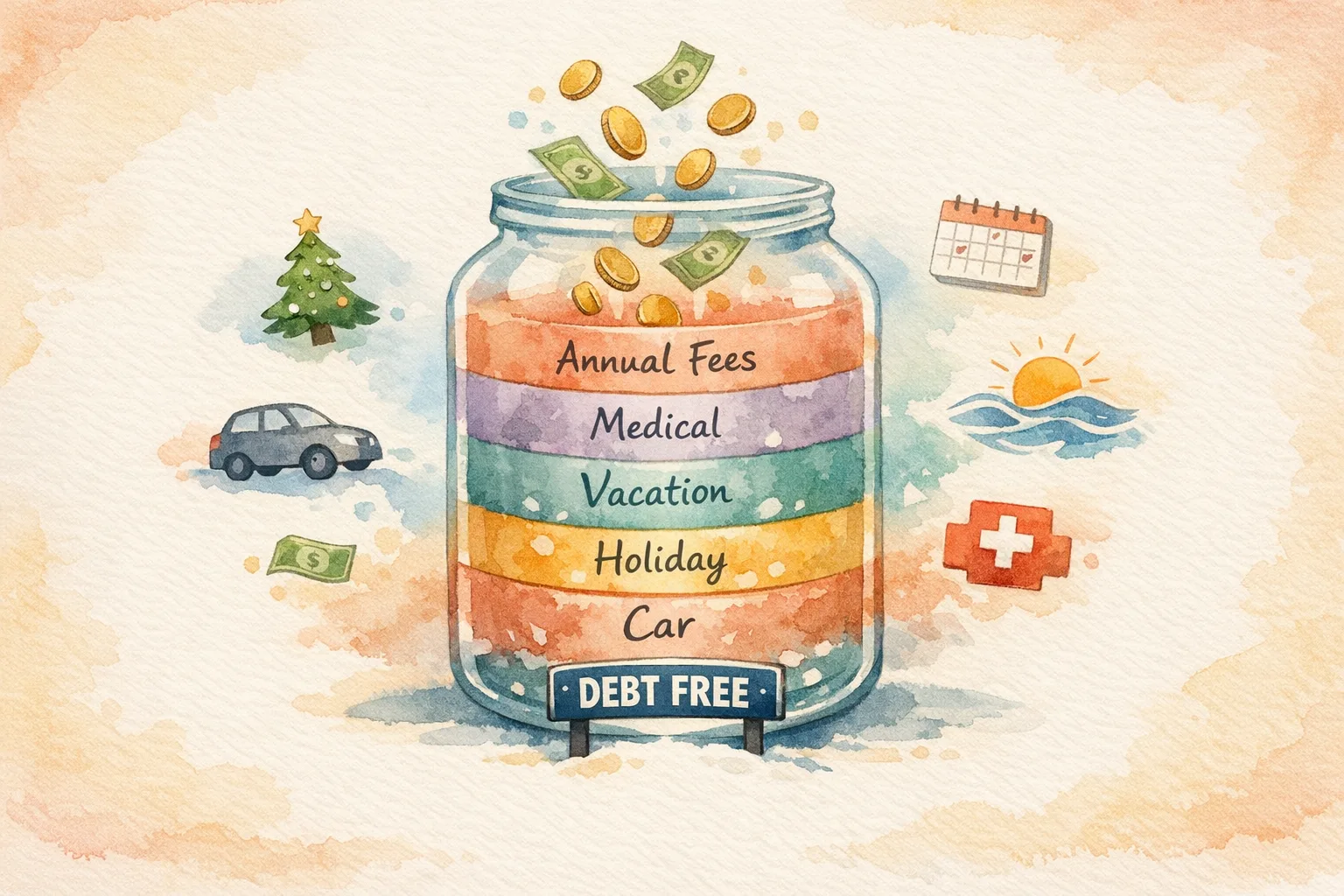
In a personal budget, a sinking fund is a named savings goal for one planned expense or type of expense. You add money to it over several pay periods, then use the balance for that purpose when the cost arrives.
The label is useful because it answers two questions: what is this money for, and when do I expect to use it? A general savings balance can hold several goals, but you still need a way to track how much belongs to each one. That can be a separate savings account, a bank sub-account, a spreadsheet, or a budgeting category.
Sinking fund examples
Common uses include:
- Annual or semiannual insurance premiums.
- Car registration, routine maintenance, or tires you expect to replace.
- School supplies, seasonal clothing, or planned holiday spending.
- A trip you have decided to take.
- An annual membership or software renewal.
- A known home, dental, or medical cost that is not due every month.
These are examples, not a checklist every household needs. Choose expenses that apply to your plans, dates, and past spending.
Sinking fund vs. emergency fund
The difference is whether you are saving for a cost you can plan for or keeping a reserve for a financial shock. The Consumer Financial Protection Bureau's emergency fund guide describes emergency savings as a reserve for unplanned expenses, such as an unexpected repair, medical bill, or loss of income.
| Sinking fund | Emergency fund | |
|---|---|---|
| Purpose | A known or planned future cost | An unplanned expense or disruption |
| Example | Saving for an insurance renewal due in October | Paying for a sudden repair after an accident |
| When you use it | When the planned bill or purchase is due | When an eligible unexpected expense occurs |
| What happens next | Recalculate contributions for the next cycle | Rebuild the reserve if you use it |
Some expense types can belong in either column, depending on the situation. For example, a scheduled service is easier to plan for than a sudden breakdown. A sinking fund can cover the part you expect; an emergency fund can help with a cost you did not expect or could not reasonably plan for.
Keep the two purposes clear in your records, even if the money sits in the same savings account. If you use emergency savings for a planned annual bill, you may have less available for a genuine financial shock.
How to calculate a sinking fund contribution
Use this formula:
Contribution per period = (target amount − current fund balance) ÷ contributions remaining
Use the amount of time you actually have. If you contribute once a month, count the monthly contributions you can make before the due date. If you contribute every payday, count those paydays instead. If the balance already meets your target, the contribution needed for that target is zero until the next cycle begins.
Worked example
Suppose your next insurance bill is expected to be $900 in nine months. You already have $180 in the labeled fund.
- Target: $900.
- Subtract the existing balance: $900 − $180 = $720.
- Divide by nine monthly contributions: $720 ÷ 9 = $80 per month.
The $900 bill and nine-month timeline are an example, not a typical price or savings recommendation. Use the actual amount on your bill or a current estimate for your own expense.
For an expense due sooner, the required contribution may be larger. For example, the same $720 remainder over four monthly deposits would require $180 per month. If that amount does not fit your budget, consider whether you can lower or delay the expense, use a smaller target, contribute a different amount, or cover the remaining cost another way. Do not assume that dividing an annual cost by twelve will fully fund it if you are starting partway through the year.
Planner
Build Your Sinking Fund Plan
Select the expense categories that apply to your life. Enter the annual amount you expect to spend, and we'll calculate your monthly contributions.
Select at least one category above to get started.
How to start a sinking fund in four steps
1. Find expenses that are planned but do not arrive monthly
Review bills, receipts, account statements, and your calendar for the last year or the period you have records for. Look for annual renewals, seasonal costs, and purchases you already expect to make. Use a bill, quote, or your own previous spending to estimate the target.
Do not treat every irregular expense as predictable. If you do not know whether a cost will happen, how much it will be, or when it might arrive, it may fit better in general savings or your emergency plan.
2. Pick a few priorities
You do not need a separate category for every possible expense. Start with the costs that have a clear due date, a useful estimate, and a meaningful effect on your cash flow. Add more goals if keeping them distinct helps you plan.
If you have little room in your budget, start with a contribution you can maintain and revisit the amount later. The CFPB's goal-setting guidance recommends comparing a plan with actual spending, making adjustments, and then automating savings if the plan fits.
3. Choose how to track the balance
You can use one savings account and track separate goals with labels, use bank sub-accounts, or maintain a budget ledger. Separate accounts are not required; what matters is that you can tell how much of the balance is reserved for each goal.
Keep the money somewhere accessible when the bill is due. If you use an automatic transfer, check that the timing works with your income and upcoming bills so you do not leave too little in checking.
4. Review the plan when the facts change
Check the estimate and due date when you receive a renewal notice, quote, or updated plan. After you pay the expense, set the next target and calculate the next contribution cycle. If you spend less than planned, keep the remainder assigned to the next cycle or redirect it deliberately.
An expense tracker can help you review what you spent in past months, but your bill or current estimate is a better starting point when you have one. For a wider budgeting framework, see our guides to zero-based budgeting and building an emergency fund.
Common sinking fund mistakes
- Using a twelve-month formula when fewer months remain. Divide by the number of contributions you can still make before the due date.
- Treating estimates as facts. Update your target when you get a bill, quote, or new information.
- Creating too many categories at once. A simple plan you can check is easier to maintain than a long list of amounts you cannot fund.
- Mixing a known bill with an emergency reserve. Keep the purpose visible, even if you store the money in one account.
- Automating without checking cash flow. Make sure transfers will not leave too little for bills and essentials; adjust them when your income or timing changes.
A simple review routine
Once a month, check the fund balance, the next due date, and whether the target still looks realistic. After you pay for something, record the actual cost and update the next cycle. This turns a sinking fund into a practical budget line: a target, a balance, a date, and a contribution you can review.
Warning
If your car inspection is every 11 months and you have had the same car for 3 years, that expense is not an emergency. When you pay it from your emergency fund, you deplete the buffer that protects you from truly unpredictable events — and then rebuild it for months while exposed to real emergencies. The definitional clarity between emergency fund and sinking fund directly determines the reliability of each.
Information
If you look back at the last 24 months and find an expense that appeared more than once — even irregularly — it is predictable enough to fund in advance. "Predictable" does not require knowing the exact month. It requires knowing it will happen with enough frequency that monthly saving makes mathematical sense.
Success
The psychological shift from sinking funds is subtle but significant. Instead of dreading December because of gift spending, you have been building a holiday fund since January. Instead of feeling guilty about a vacation, you funded it in advance. A consumer-psychology review by Greenberg and Hershfield summarizes evidence that concrete savings goals and earmarking can support saving, while also noting that goals can backfire in some situations. Use a named fund as a planning tool, not as a guarantee of lower anxiety or better financial outcomes (review in Consumer Psychology Review).
Use your spending history to plan upcoming costs
Track purchases by category in Yomio, then review past spending as you set realistic targets for the expenses you expect.
Track your spendingFrequently asked questions
More from Yomio