Travel Expense Tracker: Budget Every Trip and Spend Without Stress in 2026
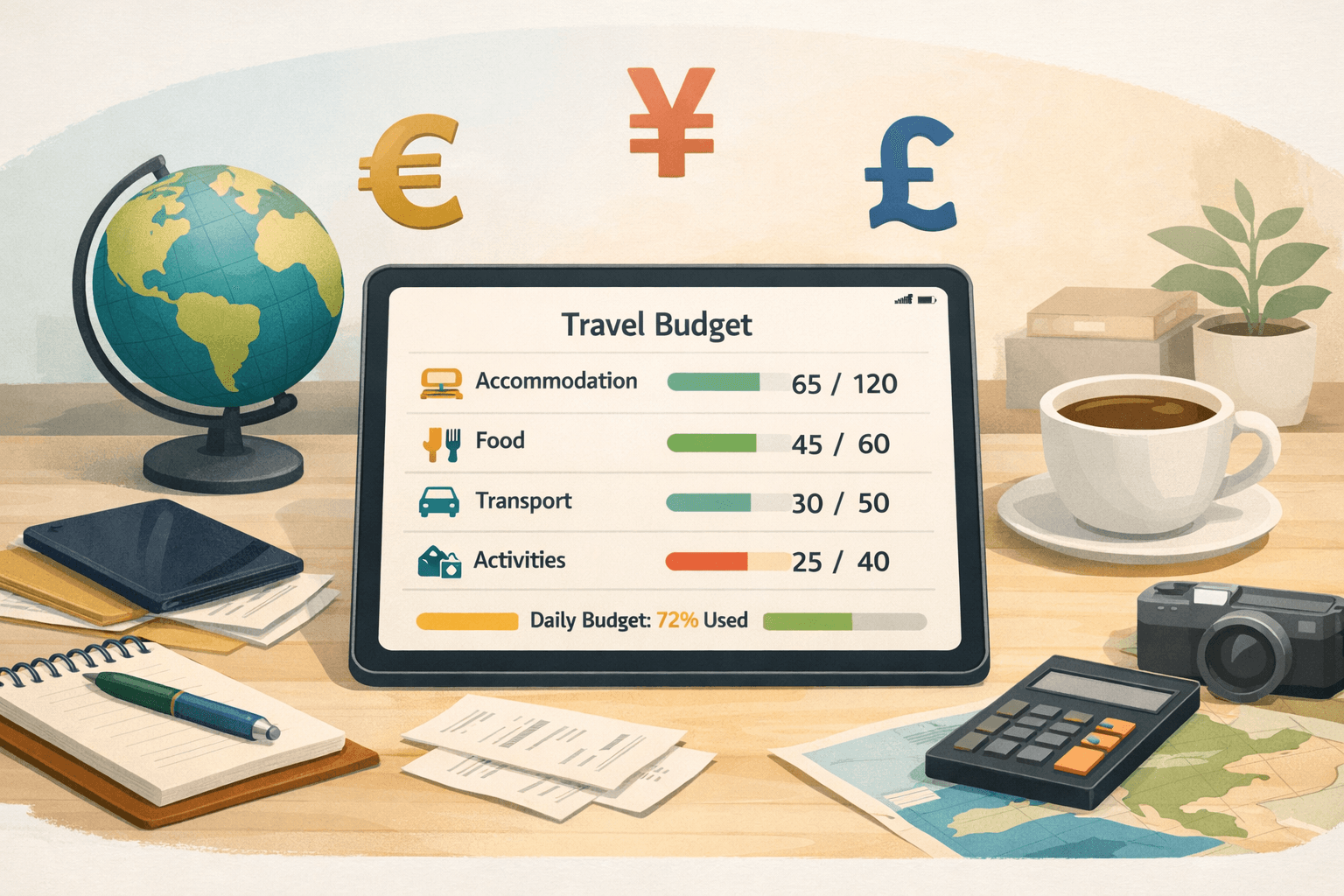
Plan your travel budget by category — accommodation, food, transport, activities — with a daily spending target. Includes multi-currency tracking for international trips.

Yulia Lit
Consumer Psychology & Behavioral Economics Researcher
Travel Expense Tracker: Budget Every Trip and Spend Without Stress in 2026
Americans who travel without a per-day spending target overspend their informal budget by an average of 42%, according to a 2025 Bankrate travel spending survey. The overspend is not random — it concentrates in two categories: dining out (where anchoring to home-city prices fails in travel contexts) and activities (where "we're on vacation" reasoning overrides normal cost sensitivity).
Tracking travel expenses is not about restricting the trip. It is about deciding in advance what each part of the trip is worth to you — so you spend more on what matters and stop leaking money into the gaps between decisions.
Key Takeaways
- A per-day budget broken down by category (accommodation, food, transport, activities) reduces trip overspend by more than half vs. a lump-sum total budget
- Accommodation typically accounts for 35–40% of total travel spend — locking this in early creates the framework for the rest of the categories
- Multi-currency tracking requires an app that converts at real exchange rates, not credit card rates — a difference of 2–4% per transaction on international trips
- Capturing receipts at point of purchase prevents the "I'll track it later" backlog that makes post-trip reconciliation useless
- Sinking funds (monthly savings toward a specific travel goal) are the most effective way to travel debt-free — calculate your monthly contribution before booking
- Trip overspend on credit cards costs an average of $348 in interest charges for US households that carry a balance, per Federal Reserve 2025 data
Why Trip Budgets Fail (And It Is Not Willpower)
Most travel budgets fail at the category level. People set a total number — "we're budgeting $3,000 for this trip" — without allocating it to specific categories. When accommodation comes in at $1,400 instead of the assumed $1,000, there is no explicit plan to absorb that overrun. The response is usually to undercut on food and activities in ways that degrade the experience, or to ignore the overrun entirely and hope the total "evens out."
It does not even out. It compounds. Dining out on vacation costs 60–80% more per meal than eating at home. Activities accumulate individual costs that each feel reasonable in isolation. By day 4 of a 7-day trip, many travelers have exhausted 80% of their informal budget and either cut the remaining days short or finish the trip in debt.
The fix is not discipline. It is a category-level daily budget set before the trip begins.
Information
Research on travel spending by Gursoy and Gavcar (2003) found that travelers who locked in accommodation costs early in the planning process made significantly more accurate total trip budget estimates than those who estimated accommodation cost loosely. Accommodation is the largest fixed cost in most trips — once it is exact, the rest of the budget becomes solvable math.
How to Build a Travel Budget by Category
The most reliable category split for travel budgeting is derived from actual spending data, not intuition. Here is the average category distribution based on US Travel Association 2025 data:
| Category | Domestic trips | International trips |
|---|---|---|
| Accommodation | 38% | 35% |
| Food & dining | 22% | 20% |
| Local transport | 14% | 18% |
| Activities & sightseeing | 16% | 17% |
| Shopping & souvenirs | 6% | 6% |
| Miscellaneous & buffer | 4% | 4% |
International trips allocate more to transport because in-country transit (trains, rideshares, local buses) is more variable and less predictable than domestic equivalents.
Use the planner below to build your specific trip budget:
Travel Budget Planner
Plan Your Trip Budget
Enter your trip length and total budget — we'll break it down by category with daily spending targets.
Enter your trip length and budget above to build your breakdown.
Step 1: Book Accommodation First, Then Build the Budget
The single highest-leverage action in travel budgeting is finalizing accommodation before estimating any other category. Once you have an exact nightly rate and have confirmed the number of nights, your accommodation cost is fixed — and that anchor lets you calculate realistic targets for every other category.
Why this order matters: Most people estimate accommodation and activities simultaneously, which means both figures are optimistic. Accommodation almost always costs more than the optimistic estimate. When the overrun hits, there is no offsetting reduction in the plan — because the plan was never explicit about trade-offs.
Practical rules for accommodation:
- Book well in advance (8–12 weeks for popular destinations) to access the widest rate range
- Include all fees in your accommodation budget: resort fees, cleaning fees, parking, taxes. The American Hotel & Lodging Association estimates that resort fees and taxes add 18–22% to the advertised nightly rate on average
- If accommodation exceeds 40% of your total budget, either reduce nights or reduce other categories explicitly before traveling
Step 2: Set a Daily Food Budget That Accounts for Destination Costs
Food spend is the most variable and most culture-dependent travel category. The same $30/day food budget that works comfortably in Lisbon covers approximately 1 full meal in Tokyo or Zurich.
Research your destination's food price level before setting your food budget:
- Numbeo's cost of living database provides meal prices for thousands of cities by category (inexpensive restaurant vs. mid-range vs. street food)
- The general rule for destination-level calibration: if a restaurant lunch for one at an inexpensive local restaurant costs more than $20, your daily food budget needs to be at least $60–$80 to eat with moderate comfort
The dining-out premium on vacation is structural, not behavioral. When you have no kitchen, every meal is a restaurant meal. Your daily food spend on vacation will be 3–5x your home daily food spend even if you are eating at exactly the same quality level. This is not overspending — it is the base cost of the trip. Budget for it explicitly.
Tip
For trips of 4+ nights, budget for one grocery shop per 3–4 days. Buying breakfast items, snacks, and lunch components at a local supermarket reduces daily food spend by $15–$25 compared to eating every meal at restaurants. This is not about deprivation — a market-bought local picnic lunch is often a better travel experience than a tourist-facing café.
Step 3: Track Every Expense the Moment You Spend
The travel tracking system only works if receipts are captured in real time. Post-trip reconstruction is unreliable — you will not remember the $23 Uber, the €7 coffee and pastry, or the $14 entry fee to a museum. Individually small, collectively significant.
The zero-friction approach with Yomio:
- Scan or photograph the receipt immediately after paying — takes 8 seconds
- Yomio auto-fills merchant, amount, and date
- Tag as the appropriate travel category (accommodation, food, transport, activities)
- For international trips: amounts are automatically converted to your home currency using live exchange rates
By the end of each travel day, open the app and check your daily total against your per-day budget. If you are ahead (under budget), you have explicit room for a splurge tomorrow. If you are behind, you can adjust tomorrow's activities rather than learning about the overrun after you're home.
Multi-Currency Tracking on International Trips
International expense tracking has one friction point that domestic travel does not: currency conversion. Most people mentally convert at a round number ("about $1 = €0.90") that diverges from the actual transaction rate — usually by 2–5%. Over a 10-day international trip with $200/day in spend, this rounding error accumulates to $40–$100 in budget visibility loss.
The problem with relying on credit card statements for international tracking:
- Statements show converted amounts days or weeks after the trip
- Transaction-level tracking is impossible until the statement posts
- No category breakdown by travel type
Yomio's approach for international trips:
- Scan receipts in any currency — Yomio converts at the mid-market rate at time of transaction
- Your dashboard shows all spending in your home currency in real time
- Category breakdown (accommodation vs. food vs. activities) works identically across currencies
Warning
When paying by card internationally, merchants sometimes offer to charge you in your home currency rather than the local currency — called Dynamic Currency Conversion (DCC). Always decline and pay in local currency. DCC rates are typically 3–7% worse than your card's exchange rate, and Visa and Mastercard research confirms it is consistently disadvantageous for the cardholder.
How to Build a Travel Sinking Fund
The most financially healthy way to travel is debt-free, funded by a monthly sinking fund accumulated before the trip. The math is simple and the execution is automatic.
Example: A $3,500 trip booked 8 months out
- Monthly contribution needed: $3,500 ÷ 8 = $437.50/month
- Open a separate high-yield savings account labeled "Travel 2026"
- Set an automatic transfer on payday for $437.50
When the trip arrives, the money is already there. No credit card interest. No post-vacation debt. No "we'll figure it out" anxiety.
For households managing multiple financial goals simultaneously, see sinking funds explained for a complete framework for setting up parallel savings categories without confusion.
More from Yomio
- Sinking funds explained — how to save for travel (and every other irregular expense) without stress
- How to save money fast — fund your next trip with freed-up everyday spend
- Monthly spending review — build the habit of reviewing spend that makes travel budgets stick
- How to stop overspending using alerts — set per-category alerts for your trip budget