What Is Doom Spending — And How to Break the Cycle in 2026
Doom spending is buying as emotional relief from economic anxiety — and 1 in 5 Americans do it regularly. Here is the science behind it and a practical system to stop.

Yulia Lit
Consumer Psychology & Behavioral Economics Researcher
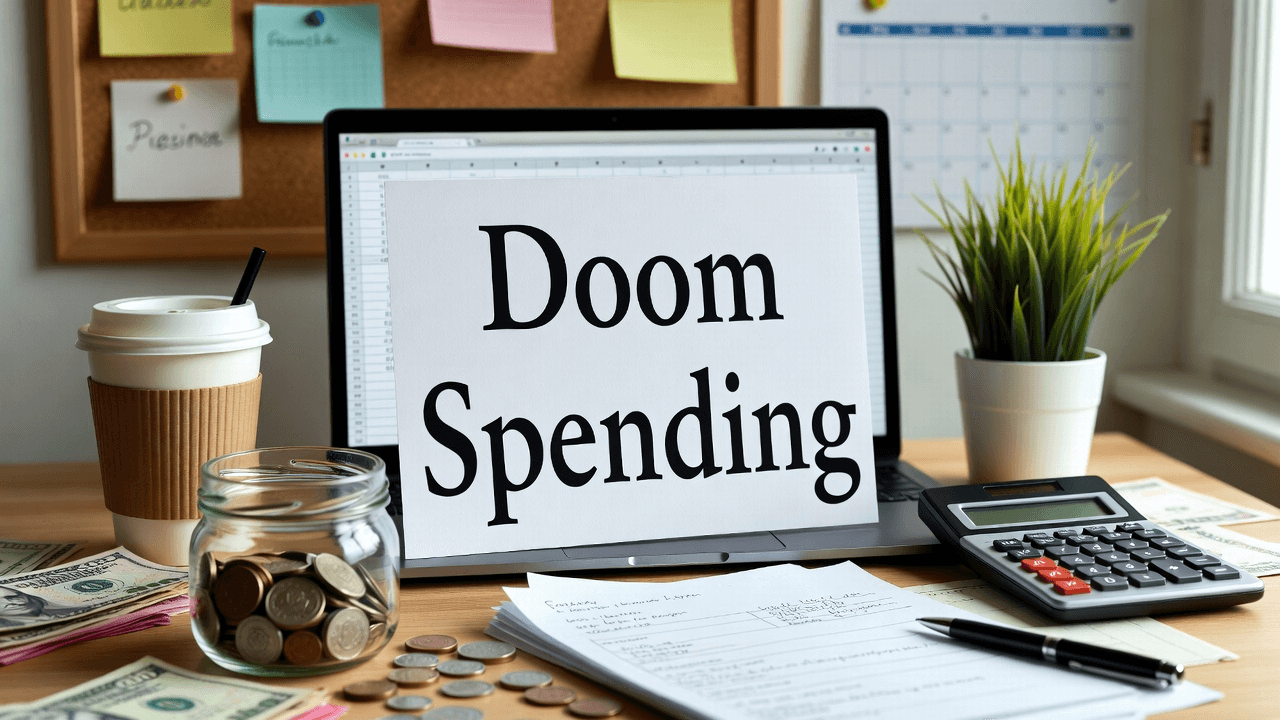
What Is Doom Spending — And How to Break the Cycle in 2026
1 in 5 Americans now doom-spend regularly — buying things they do not need as a response to economic anxiety, political stress, or a vague sense that the future is uncertain, so why not enjoy the present. CNBC reported this figure in early 2026, and the pattern is accelerating: among Gen Z specifically, 30% of respondents in a Barclays study admitted to stress-driven purchases, up from 19% just two years prior.
The financial consequence is measurable. Doom spenders carry an average of $3,580 more in credit card debt than comparable people who do not doom-spend, yet report no proportional increase in life satisfaction. The dopamine hit from a purchase evaporates within hours. The debt does not.
Understanding doom spending — what drives it at a neurological level, and what actually interrupts the cycle — is the difference between feeling guilty every time you open your bank app and building a purchasing pattern you can live with long-term.
Key Takeaways
- Doom spending is purchasing driven by economic anxiety and global uncertainty — not genuine desire for the item
- Approximately 1 in 5 Americans engage in it regularly; Gen Z is disproportionately affected
- The mechanism is neurological: short-term dopamine suppresses anxiety temporarily, building a reinforcement loop
- Doom spending differs from normal impulse buying because the trigger is chronic ambient stress, not situational temptation
- Breaking the cycle requires interrupting the trigger, not just resisting the purchase — willpower alone fails
- Expense tracking creates the cognitive gap that awareness-based interruption methods require
What Is Doom Spending, Exactly?
Doom spending is a specific form of emotional spending triggered by macroeconomic or geopolitical anxiety. It is distinct from general impulse buying (triggered by situational temptation — a sale, a product recommendation) in a critical way: the trigger is not the item or the store. The trigger is baseline anxiety about the state of the world.
The pattern typically looks like this:
- Person reads news about inflation, job market instability, housing prices, climate events, or political uncertainty
- A diffuse sense of anxiety and helplessness builds
- Person opens a shopping app — sometimes without consciously deciding to
- Browsing and eventually purchasing provides a brief, real dopamine release
- Anxiety momentarily decreases
- Within hours, it returns, often now combined with guilt about the purchase
The term gained significant traction in 2023 and has continued to grow as a recognized behavioral pattern. Psychologist Laurie Santos of Yale, who teaches the most popular course in Yale's history on happiness and behavior, identifies it as a textbook example of hedonic adaptation failure — repeatedly seeking a pleasure that consistently fails to deliver lasting relief.
Warning
Not all emotional spending is doom spending. Deliberately buying something to reward yourself after an achievement, or budgeting for "fun money" with intention, is not the same pattern. Doom spending is distinguished by: (1) the trigger is anxiety, not joy or accomplishment, (2) the purchase is unplanned and often not particularly wanted, and (3) guilt follows the brief relief. If the purchase was in your budget and you felt satisfied, that is not doom spending.
The Neuroscience Behind the Loop
To understand why willpower alone does not work, you need to understand what is happening in the brain during a doom spending episode.
The trigger phase: Exposure to stressful information activates the amygdala — the brain's threat-detection system. The amygdala does not distinguish between a physical threat (predator) and a conceptual threat (recession). Both produce cortisol and a fight-or-flight stress response.
The seek phase: In the absence of a concrete threat to respond to, the brain moves toward behaviors associated with past relief — in modern humans, acquisition is one of the most powerful. The nucleus accumbens (dopamine reward pathway) activates in anticipation of a purchase. This anticipatory dopamine spike is what drives the compulsive browsing behavior. Crucially, the dopamine spike happens in anticipation, not on delivery — which is why people often feel let down immediately after buying something they urgently "needed."
The purchase phase: The transaction triggers a brief suppression of cortisol. Anxiety genuinely decreases — this is the real relief people report. It is not imagined.
The return phase: Within 2–4 hours, cortisol stabilizes at its previous level. The anxiety returns. The item is there but provides no further relief. Guilt about the purchase may now add a second stressor on top of the original one.
This is a textbook negative reinforcement loop: a behavior (purchasing) relieves an aversive state (anxiety) temporarily, increasing the probability of the same behavior when anxiety next occurs. Each repetition makes the loop slightly stronger. It is the same neurological architecture as other compulsive behaviors.
Information
Research by neuroscientist Wolfram Schultz on dopamine and reward prediction found that dopamine fires most strongly in anticipation of a reward, not on receiving it. This is why browsing a shopping site feels better than opening the package — and why doom spenders often return to shopping apps within days of receiving their last purchase. The reward is the seeking, not the finding.
Who Is Most Vulnerable to Doom Spending?
Gen Z and younger Millennials are disproportionately affected for several structural reasons:
- Higher ambient economic anxiety: Younger cohorts entered adulthood during or after 2008 (Millennials) or 2020 (Gen Z) — periods of significant economic disruption that shape financial beliefs at formative stages
- Higher social media exposure: Platforms algorithmically amplify anxiety-inducing content (high engagement) while embedding direct purchasing with one-tap checkout
- Higher BNPL usage: Buy Now, Pay Later services make purchases feel even more consequence-free in the moment, reducing the friction that might interrupt the loop
- Weaker financial safety nets: Fewer have emergency funds, employer pensions, or family wealth buffers — which increases the rational basis for anxiety and reduces the psychological sense of security that buffers impulsive responding
Self-assessment
Are You Doom Spending?
Rate each statement honestly. This takes about 90 seconds.
I often open a shopping app without intending to buy anything.
I make purchases I don't care much about after reading or watching the news.
I feel a brief sense of relief after buying something, but it disappears quickly.
I sometimes feel guilty about purchases I made under stress.
I spend more when I feel anxious or uncertain about the future.
I've bought things I couldn't really justify just to feel in control of something.
My unplanned spending has increased over the past 12 months.
I use online shopping as a way to unwind or distract myself.
Why "Just Stop Buying Things" Does Not Work
The conventional advice for any form of emotional spending is willpower-based: be more disciplined, want things less, think before you buy. This advice is genuinely useless for doom spending, and research explains exactly why.
A study by Hofmann et al. (2012) on self-control and desire found that people who most frequently tried to resist desires reported feeling worse — not better — over time. Suppression of urges requires cognitive effort that depletes regulatory resources, leaving less capacity to resist the next urge. It is a losing arms race.
More fundamentally, willpower addresses the purchase without addressing the trigger. If the underlying cortisol load from ambient anxiety persists, the pressure to find relief persists. Blocking one outlet (shopping) without addressing the underlying state simply redirects the behavior — often toward other relief-seeking behaviors (eating, social media, alcohol).
Effective interruption of doom spending targets either:
- The trigger (reducing cortisol load through evidence-based stress management)
- The gap between trigger and response (creating enough delay that the automatic response can be interrupted)
- The reinforcement (making the post-purchase experience less relieving, not more)
5 Systems That Actually Interrupt Doom Spending
These are not exhortations to try harder. They are structural mechanisms that change the conditions under which the loop can complete.
1. The Friction Insertion Method
The doom spending loop completes quickly because it requires almost no friction. One-click checkout, saved card details, BNPL at checkout, phone in your hand already open: the path from anxiety to purchase is 30 seconds.
Add friction:
- Delete saved payment methods from your most frequently used shopping apps
- Move shopping apps to a folder three swipes deep (not your home screen)
- Log out of shopping accounts (re-entering credentials takes 90 seconds — long enough for the urgency to partially subside)
- Install a browser extension that replaces Amazon product pages with a 5-minute delay counter
Research on checkout friction by Soman and Gourville (2001) found that even minor obstacles (a single additional click) significantly reduced unplanned purchases. You do not need the barrier to be large — it needs to interrupt the automaticity of the loop, creating space for a deliberate decision.
2. The Public Commitment Commitment
Doom spending is usually a private behavior. Publicness costs nothing, but it creates social accountability that activates a different set of motivations.
Method: Tell one specific person (not social media — a single trusted person) that you are working on doom spending. Agree on a simple check-in: once a week, you briefly mention whether you made any unplanned purchases. The social bond does not prevent purchases — it creates a moment of future visibility that the brain factors into present-moment decisions.
Commitment device research by Ariely and Wertenbroch (2002) consistently shows that pre-committed public accountability reduces impulsive behavior far more reliably than private intention-setting.
3. The "Cortisol Audit" Rule
Before any unplanned purchase, spend 60 seconds identifying the emotional state that preceded the urge. Not judgment — diagnosis.
Ask: "Am I buying this because I genuinely want this item, or am I buying it because I feel [anxious / bored / helpless / overwhelmed]?"
This sounds trivially simple. It works because naming an emotional state reduces its intensity — a process called affect labeling, backed by neuroimaging research from UCLA. The act of naming the anxiety activates the prefrontal cortex (deliberate reasoning) and reduces amygdala activity (reactive responding). The anxious urgency decreases slightly. That slight decrease is sufficient for many people to make a different decision.
Success
Affect labeling works better when spoken rather than just thought. If you are about to make an impulsive purchase, try saying out loud (or typing into your notes app): "I feel anxious about [specific thing] and I am about to buy [item] to feel better." The act of explicit narration activates a level of deliberate processing that breaks the automatic response loop. It feels strange the first five times. It becomes a useful pause mechanism.
4. The Cortisol Displacement Strategy
If the underlying anxiety is the trigger, deliberately providing it with a more effective outlet reduces the pressure on purchasing as a relief mechanism.
The evidence-backed cortisol reducers are well-established:
- 10–20 minutes of physical movement reduces cortisol by a measurable amount within 30 minutes (any movement — a walk, not a gym session)
- Social connection: Research from Harvard's 85-year study on happiness identifies social contact as the single most reliable mood stabilizer — a 10-minute call with someone you like outperforms a purchase every time
- Exposure completion: Anxiety about an uncertain future is worsened by avoidance. Reading or listening to the stressful news story completely — then putting it down deliberately — tends to decrease anxiety more than partial exposure and flight
None of these require willpower. They redirect the cortisol-relief seeking toward behaviors that provide more durable relief than a purchase does.
5. The Spending Visibility Method
Doom spending thrives in the dark. People who do not track their expenses have no clear sense of their total spending or its consequences — which removes a key piece of the decision-making context.
When you open a shopping app, implicit knowledge that your dining budget is already 15% over and your credit card balance is higher than you would like it to be changes the salience of the purchase. This is not guilt-induction — it is relevant context that was previously unavailable.
Studies on the "pain of paying" show that the psychological cost of a purchase — the inhibitory signal — depends entirely on how clearly the person perceives the financial reality of their situation. Cash creates high clarity. Contactless payment creates almost none. Active expense tracking creates partial clarity that nudges in the right direction.
Maintaining a clear, current view of your expense categories — even just opening your tracking app before opening a shopping app — creates enough contextual awareness to shift some proportion of purchases from impulsive to deliberate.
How Much Is Doom Spending Costing You?
The aggregate number matters. Most doom spenders are aware of individual purchases but do not add them up. The sum is usually more alarming than the parts.
Step 1: Open your bank statements or expense tracking data for the last 3 months.
Step 2: Flag every purchase that was (a) unplanned at the start of the day, (b) not a necessity, and (c) preceded by a moment of stress or anxiety (even if you cannot remember the exact trigger).
Step 3: Add them up.
In our internal analysis, users who identified doom spending as a pattern found that it accounted for an average of £180–£340/month in categorizable unplanned purchases — often spread across clothing, home delivery, small electronics, and online subscriptions. Annualized, that is £2,160–£4,080 in purchases driven primarily by emotional state rather than genuine want.
That number, made visible, is one of the more effective motivators for behavior change — not because guilt is useful, but because concrete costs are more real than abstract awareness.
The Connection to Subscription Debt and BNPL Stacking
Doom spending frequently overlaps with two other financial patterns that compound its damage:
Subscription accumulation: A doom-spending session often includes signing up for a service (a meditation app, a streaming platform, a shopping membership) rather than buying a physical item. These subscriptions auto-renew indefinitely, convert a one-time impulse into an ongoing cost, and then fall into subscription fatigue — the zombie charges you forget entirely but keep paying.
BNPL stacking: Doom spenders are disproportionate users of Buy Now, Pay Later services because BNPL eliminates the most visible friction point (seeing the full amount charged). Each individual BNPL plan feels small. Multiple overlapping plans create a commitment that previous-month-you can no longer see clearly. See the full analysis of how BNPL services engineer spending blindness.
Addressing doom spending in isolation while leaving subscriptions untrimmed and BNPL plans accumulating is addressing one source while leaving two others running.
Tracking as a Foundation, Not a Solution
Expense tracking does not cure doom spending. Only interrupting the trigger-response loop can do that. What tracking does is provide the data infrastructure that makes several of the interventions above possible:
- You can only count the monthly cost if you have the data
- You can only see category overruns in real time if you are recording purchases
- The cortisol audit becomes more concrete when you have a number attached to the behavior
Scan your receipts. Log your purchases. Not to punish yourself after the fact — to give yourself the information you need to make the interventions above work.
See your spending patterns before they become habits
Yomio captures every purchase — including the unplanned ones — so you can identify your doom spending triggers and track the impact. Free to start, no bank link required.
Track my spending for freeFrequently Asked Questions
Is doom spending a form of addiction? It shares structural features with behavioral addictions (reinforcement loop, tolerance, withdrawal-like anxiety when the behavior is blocked) but mental health professionals do not currently classify it as a formal addiction disorder. The practical implication: the same behavioral change frameworks that work for behavioral repetition patterns work here — disrupting the cue-routine-reward loop, as described in James Clear's Atomic Habits and Charles Duhigg's The Power of Habit.
Can doom spending be healthy in moderation? Small intentional purchases as a deliberate stress management tool, within a budget, with awareness — that is managed emotional spending. The problem is when the behavior is automatic and unmonitored, and when the financial consequence compounds over time. Intention is the dividing line.
My spouse or partner doom-spends and it affects our shared finances. What do I do? This requires a money conversation about shared financial goals, not a conversation about the spending behavior itself. Criticizing the behavior directly typically triggers defensiveness and escalates the anxiety that drives it. Start with shared goals (what do we want our financial situation to look like in 3 years?) and work backward to what behaviors serve those goals.
I doom-spend because I genuinely feel hopeless about ever having financial security. Is that different? If the underlying belief is that financial security is structurally unavailable to you — which for some people reflects a rational assessment of real conditions — the interventions above are palliative, not curative. The more fundamental work is addressing the financial planning that might actually create some security (emergency fund, income changes, debt reduction). Our guide on how to stop living paycheck to paycheck addresses the structural side.
More from Yomio
How Impulse Spending Is a System Design, Not a Personal Flaw
The dark patterns engineering your purchasing behavior.

Buy Now, Pay Later Is Quietly Destroying Your Budget
How BNPL amplifies doom spending damage.

Why You Spend 40% More Than You Think
The neuroscience of spending invisibility.